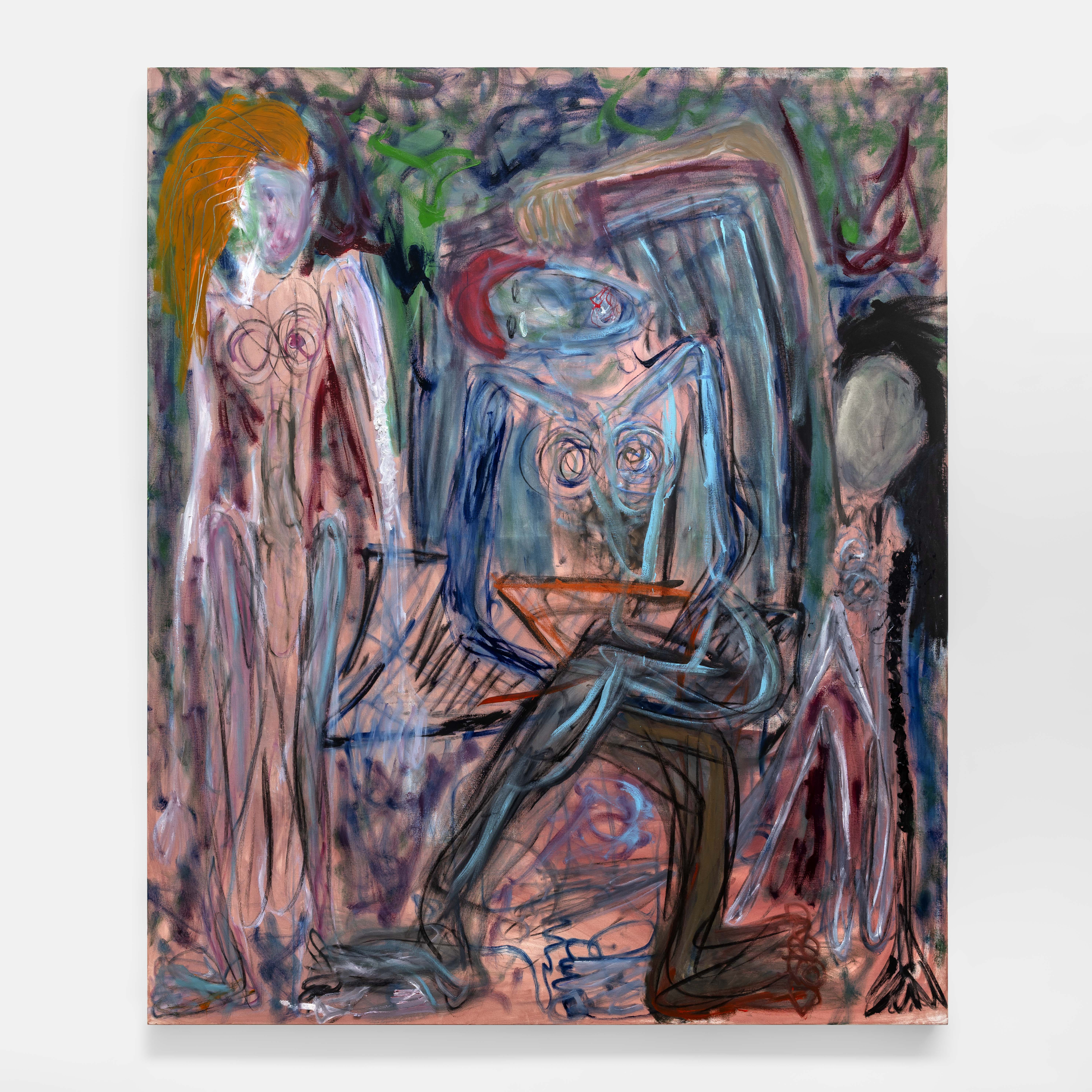
Lee Krasner, Combat, 1965. Photograph © 2026 Pollock-Krasner Foundation : Artists Rights Society (ARS), New York.
The exhibition begins with the artists’ separate paths before they met in New York in 1941. Krasner, a Brooklyn-born artist trained in the traditions of European modernism, had established herself in the city’s art world before Pollock achieved widespread recognition. She became an important advocate for his work, introducing him to influential artists and critics. Their marriage in 1945 and subsequent move to Springs, Long Island, brought them into a shared environment that would become central to the development of their art.
Yet the exhibition’s achievement lies in resisting the temptation to treat their work as a single, blended enterprise. Pollock’s breakthrough drip paintings, with their intricate webs of poured and flung paint, transformed the canvas into a record of physical movement. Their scale and apparently uncontrolled energy remain compelling, even as the paintings reveal an underlying attention to rhythm, density and composition.
Krasner’s achievement is less easily reduced to a signature style. Her work moves between fractured geometries, gestural abstraction, vivid color and collage. Where Pollock’s most famous paintings can seem to pursue a single, sustained visual language, Krasner repeatedly reinvented hers. The exhibition makes this restlessness a strength, revealing an artist who regarded abstraction not as a destination but as an open-ended investigation.
The contrast becomes especially revealing when the two artists’ works are placed in proximity. Their visual affinities—sinuous lines, organic forms and all-over compositions—suggest shared interests, including their engagement with Henri Matisse. But the similarities do not erase their differences. Instead, the paintings suggest how artistic influence can operate within a relationship without diminishing either participant’s individuality.
One of the exhibition’s most affecting sections concerns Krasner’s turn to collage in the early 1950s. She cut up unsold paintings and incorporated fragments of earlier work, including discarded drawings by Pollock, into new compositions. This act of artistic recycling becomes a metaphor for the exhibition as a whole: the past is not something to be discarded but material to be reconsidered, dismantled and made new. Krasner’s willingness to destroy and remake her own work stands in sharp contrast to the more concentrated direction of Pollock’s mature style.
The emotional complications of their life together are never far from the art. Pollock’s alcoholism, infidelity and psychological struggles placed increasing strain on the marriage. His death in a car crash in 1956 left Krasner to contend with both her grief and the immense reputation he had acquired. She eventually moved her studio into the barn where he had painted, claiming a space that had previously been his domain.
Her subsequent work, including the monumental The Seasons (1957), demonstrates how thoroughly she transformed that inheritance. Spanning roughly 17 feet, the painting combines expansive gestures, lush colors and organic forms in a composition that feels both bodily and exuberant. Rather than simply extending Pollock’s achievement, Krasner uses comparable scale to pursue a different emotional register. The painting is evidence of an artist discovering new possibilities after devastating personal loss.
The final section, which takes its title from Krasner’s 1976 painting Past Continuous, brings the exhibition’s argument into focus. Decades-old drawings reappear as fragments in new paintings, while Pollock’s Portrait and a Dream (1953) places an abstract composition beside a recognizable face. Both artists, in different ways, return to earlier imagery without simply repeating it. The past remains active, unsettled and open to reinterpretation.
There is a potential limitation to an exhibition organized around a famous relationship: the temptation to interpret every formal resemblance as evidence of mutual influence. At times, the biographical narrative threatens to overshadow the individual works. But the curators largely avoid that trap by allowing the paintings to maintain their independence, even when their juxtaposition invites comparison.
Ultimately, Krasner and Pollock: Past Continuous succeeds because it does more than correct the historical imbalance between two artists. It demonstrates how much is lost when Krasner is understood chiefly through Pollock, or Pollock through the legend of his marriage. Their lives intersected, their work sometimes converged, and their personal relationship was frequently painful. Yet each pursued a distinct artistic vision.
The exhibition’s most valuable insight is that artistic history need not be a contest in which one achievement diminishes another. By presenting Krasner and Pollock as peers, the Met offers a richer account of Abstract Expressionism—and a reminder that the most interesting creative relationships are rarely as simple as their legends suggest.
The exhibition is on view at the Met Fifth Avenue through Jan. 31, 2027.