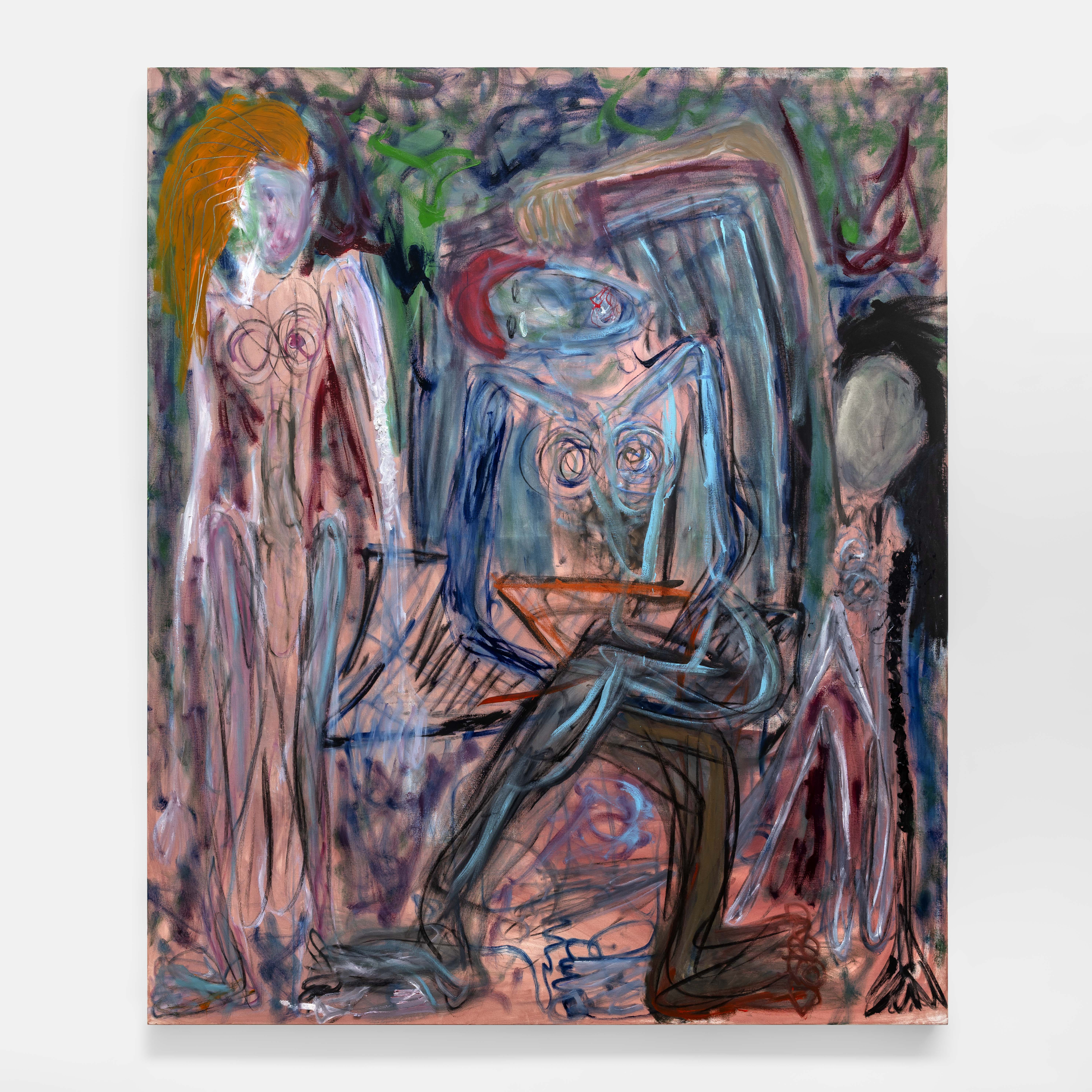
Installation view of “Susan Silton: Diving Into the Wreck” at Los Angeles Municipal Art GalleryCredit...Los Angeles Municipal Art Gallery, Photo by Brian Forrest.
The title comes from Adrienne Rich’s 1972 poem “Diving into the Wreck,” in which an underwater expedition becomes a metaphor for confronting submerged histories. Rich’s ideas about language as a means of orientation provide an apt framework for Silton, whose work repeatedly moves between the personal and the public. Her materials may be humble—posters, photographs, printed matter, found images—but they are rarely passive. Words become visual objects, while images operate almost like sentences.
One of the exhibition’s pleasures is the way it resists a single medium or signature style. Silton’s practice has included graphic projects, stereoscopic photographs, participatory installations and video works, among other forms. “Mutation #6 (Somewhere in the Middle)” (1994), from her mutatis mutandis series, incorporates an antique stereoscope, turning the act of looking into part of the work itself. “Inside Out” (2007), originally created for the Pasadena Museum of California Art, similarly turns installation into an encounter rather than something simply to be viewed.
The emotional center of the exhibition is perhaps found in works dealing with loss and public memory. broken Water (1993), for example, addresses mothers and caretakers mourning gay sons during the early years of the HIV/AIDS pandemic. Later works, including The stain of ______. A stain on ____. (2018), shift toward a more oblique language of disappointment, using photographs of stains found on Los Angeles streets as fragments of a damaged civic landscape.
Outside the gallery, “Civilized Voices” extends Silton’s concerns into Barnsdall Park itself. Five hand-painted billboards, installed among the park’s pine trees, carry newly commissioned texts by Los Angeles poets Rocío Carlos, Erin Marie Lynch, Lynne Thompson and Terry Wolverton, with Cathy Linh Che also listed among the commissioned writers in the exhibition materials. The project draws on Aline Barnsdall’s own use of billboards for social and political messages in the 1940s, creating an especially appropriate dialogue between the park’s history and Silton’s interest in public address.
What ultimately distinguishes “Diving into the Wreck” is its insistence that looking can be an active form of participation. Silton does not make work that simply illustrates ideas; she constructs situations in which viewers have to negotiate images, words, histories and their own assumptions. At Barnsdall Park, that investigation spills beyond the gallery walls, turning the exhibition into both an archive and a conversation.